Hunt down social media accounts by username across social networks

Hunt down social media accounts by username across 400+ social networks
Installation • Usage • Contributing

Installation
Warning
Packages for ParrotOS and Ubuntu 24.04, maintained by a third party, appear to be broken.
Users of these systems should defer to pipx/pip or Docker.
| Method | Notes |
|---|---|
pipx install sherlock-project |
pip may be used in place of pipx |
docker run -it --rm sherlock/sherlock |
|
dnf install sherlock-project |
Community-maintained packages are available for Debian (>= 13), Ubuntu (>= 22.10), Homebrew, Kali, and BlackArch. These packages are not directly supported or maintained by the Sherlock Project.
See all alternative installation methods here
General usage
To search for only one user:
sherlock user123
To search for more than one user:
sherlock user1 user2 user3
Accounts found will be stored in an individual text file with the corresponding username (e.g user123.txt).
$ sherlock --help
usage: sherlock [-h] [--version] [--verbose] [--folderoutput FOLDEROUTPUT]
                [--output OUTPUT] [--tor] [--unique-tor] [--csv] [--xlsx]
                [--site SITE_NAME] [--proxy PROXY_URL] [--json JSON_FILE]
                [--timeout TIMEOUT] [--print-all] [--print-found] [--no-color]
                [--browse] [--local] [--nsfw]
                USERNAMES [USERNAMES ...]

Sherlock: Find Usernames Across Social Networks (Version 0.14.3)

positional arguments:
  USERNAMES             One or more usernames to check with social networks.
                        Check similar usernames using {?} (replace to '_', '-', '.').

optional arguments:
  -h, --help            show this help message and exit
  --version             Display version information and dependencies.
  --verbose, -v, -d, --debug
                        Display extra debugging information and metrics.
  --folderoutput FOLDEROUTPUT, -fo FOLDEROUTPUT
                        If using multiple usernames, the output of the results will be
                        saved to this folder.
  --output OUTPUT, -o OUTPUT
                        If using single username, the output of the result will be saved
                        to this file.
  --tor, -t             Make requests over Tor; increases runtime; requires Tor to be
                        installed and in system path.
  --unique-tor, -u      Make requests over Tor with new Tor circuit after each request;
                        increases runtime; requires Tor to be installed and in system
                        path.
  --csv                 Create Comma-Separated Values (CSV) File.
  --xlsx                Create the standard file for the modern Microsoft Excel
                        spreadsheet (xlsx).
  --site SITE_NAME      Limit analysis to just the listed sites. Add multiple options to
                        specify more than one site.
  --proxy PROXY_URL, -p PROXY_URL
                        Make requests over a proxy. e.g. socks5://127.0.0.1:1080
  --json JSON_FILE, -j JSON_FILE
                        Load data from a JSON file or an online, valid, JSON file.
  --timeout TIMEOUT     Time (in seconds) to wait for response to requests (Default: 60)
  --print-all           Output sites where the username was not found.
  --print-found         Output sites where the username was found.
  --no-color            Don't color terminal output
  --browse, -b          Browse to all results on default browser.
  --local, -l           Force the use of the local data.json file.
  --nsfw                Include checking of NSFW sites from default list.
Apify Actor Usage 

You can run Sherlock in the cloud without installation using the Sherlock Actor on Apify free of charge.
$ echo '{"usernames":["user123"]}' | apify call -so netmilk/sherlock
[{
  "username": "user123",
  "links": [
    "https://www.1337x.to/user/user123/",
    ...
  ]
}]
Read more about the Sherlock Actor, including how to use it programmatically via the Apify API, CLI and JS/TS and Python SDKs.
Credits
Thank you to everyone who has contributed to Sherlock! ❤️
Star History
License
MIT © Sherlock Project
Original Creator - Siddharth Dushantha
Teams-first Multi-agent orchestration for Claude Code
English | 한국어 | 中文 | 日本語 | Español | Tiếng Việt | Português
oh-my-claudecode






For Codex users: Check out oh-my-codex — the same orchestration experience for OpenAI Codex CLI.
Multi-agent orchestration for Claude Code. Zero learning curve.
Don't learn Claude Code. Just use OMC.
Get Started • Documentation • CLI Reference • Workflows • Migration Guide • Discord
Quick Start
Step 1: Install
Marketplace/plugin install (recommended for most Claude Code users):
/plugin marketplace add https://github.com/Yeachan-Heo/oh-my-claudecode
/plugin install oh-my-claudecode
If you prefer the npm CLI/runtime path instead of the marketplace flow:
npm i -g oh-my-claude-sisyphus@latest
Step 2: Setup
/setup
/omc-setup
Step 3: Build something
autopilot: build a REST API for managing tasks
That's it. Everything else is automatic.
Not Sure Where to Start?
If you're uncertain about requirements, have a vague idea, or want to micromanage the design:
/deep-interview "I want to build a task management app"
The deep interview uses Socratic questioning to clarify your thinking before any code is written. It exposes hidden assumptions and measures clarity across weighted dimensions, ensuring you know exactly what to build before execution begins.
Team Mode (Recommended)
Starting in v4.1.7, Team is the canonical orchestration surface in OMC. The legacy swarm keyword/skill has been removed; use team directly.
/team 3:executor "fix all TypeScript errors"
Team runs as a staged pipeline:
team-plan → team-prd → team-exec → team-verify → team-fix (loop)
Enable Claude Code native teams in ~/.claude/settings.json:
{
  "env": {
    "CLAUDE_CODE_EXPERIMENTAL_AGENT_TEAMS": "1"
  }
}
If teams are disabled, OMC will warn you and fall back to non-team execution where possible.
tmux CLI Workers — Codex & Gemini (v4.4.0+)
v4.4.0 removes the Codex/Gemini MCP servers (x, g providers). Use the CLI-first Team runtime (omc team ...) to spawn real tmux worker panes:
omc team 2:codex "review auth module for security issues"
omc team 2:gemini "redesign UI components for accessibility"
omc team 1:claude "implement the payment flow"
omc team status auth-review
omc team shutdown auth-review
/omc-teams remains as a legacy compatibility skill and now routes to omc team ....
For mixed Codex + Gemini work in one command, use the /ccg skill (routes via /ask codex + /ask gemini, then Claude synthesizes):
/ccg Review this PR — architecture (Codex) and UI components (Gemini)
| Surface | Workers | Best For |
|---|---|---|
omc team N:codex "..." |
N Codex CLI panes | Code review, security analysis, architecture |
omc team N:gemini "..." |
N Gemini CLI panes | UI/UX design, docs, large-context tasks |
omc team N:claude "..." |
N Claude CLI panes | General tasks via Claude CLI in tmux |
/ccg |
/ask codex + /ask gemini | Tri-model advisor synthesis |
Workers spawn on-demand and die when their task completes — no idle resource usage. Requires codex / gemini CLIs installed and an active tmux session.
Note: Package naming — The project is branded as oh-my-claudecode (repo, plugin, commands), but the npm package is published as
oh-my-claude-sisyphus. If you install or upgrade the CLI tools via npm/bun, usenpm i -g oh-my-claude-sisyphus@latest.
Updating
If you installed OMC via npm, upgrade with the published package name:
npm i -g oh-my-claude-sisyphus@latest
Package naming note: the repo, plugin, and commands are branded oh-my-claudecode, but the published npm package name remains
oh-my-claude-sisyphus.
If you installed OMC via the Claude Code marketplace/plugin flow, update with:
# 1. Update the marketplace clone
/plugin marketplace update omc

# 2. Re-run setup to refresh configuration
/setup
If you are developing from a local checkout or git worktree, update the checkout first, then re-run setup from that worktree so the active runtime matches the code you are testing.
Note: If marketplace auto-update is not enabled, you must manually run
/plugin marketplace update omcto sync the latest version before running setup.
If you experience issues after updating, clear the old plugin cache:
/omc-doctor
Your Claude Just Have been Steroided.

Why oh-my-claudecode?
- Zero configuration required - Works out of the box with intelligent defaults
- Team-first orchestration - Team is the canonical multi-agent surface
- Natural language interface - No commands to memorize, just describe what you want
- Automatic parallelization - Complex tasks distributed across specialized agents
- Persistent execution - Won't give up until the job is verified complete
- Cost optimization - Smart model routing saves 30-50% on tokens
- Learn from experience - Automatically extracts and reuses problem-solving patterns
- Real-time visibility - HUD statusline shows what's happening under the hood
Features
Orchestration Modes
Multiple strategies for different use cases — from Team-backed orchestration to token-efficient refactoring. Learn more →
| Mode | What it is | Use For |
|---|---|---|
| Team (recommended) | Canonical staged pipeline (team-plan → team-prd → team-exec → team-verify → team-fix) |
Coordinated Claude agents on a shared task list |
| omc team (CLI) | tmux CLI workers — real claude/codex/gemini processes in split-panes |
Codex/Gemini CLI tasks; on-demand spawn, die when done |
| ccg | Tri-model advisors via /ask codex + /ask gemini, Claude synthesizes |
Mixed backend+UI work needing both Codex and Gemini |
| Autopilot | Autonomous execution (single lead agent) | End-to-end feature work with minimal ceremony |
| Ultrawork | Maximum parallelism (non-team) | Burst parallel fixes/refactors where Team isn't needed |
| Ralph | Persistent mode with verify/fix loops | Tasks that must complete fully (no silent partials) |
| Pipeline | Sequential, staged processing | Multi-step transformations with strict ordering |
| Ultrapilot (legacy) | Deprecated compatibility mode (autopilot pipeline alias) | Existing workflows and older docs |
Intelligent Orchestration
- 32 specialized agents for architecture, research, design, testing, data science
- Smart model routing - Haiku for simple tasks, Opus for complex reasoning
- Automatic delegation - Right agent for the job, every time
Developer Experience
- Magic keywords -
ralph,ulw,ralplan; Team stays explicit via/team - HUD statusline - Real-time orchestration metrics in your status bar
- Skill learning - Extract reusable patterns from your sessions
- Analytics & cost tracking - Understand token usage across all sessions
Custom Skills
Learn once, reuse forever. OMC extracts hard-won debugging knowledge into portable skill files that auto-inject when relevant.
| Project Scope | User Scope | |
|---|---|---|
| Path | .omc/skills/ |
~/.omc/skills/ |
| Shared with | Team (version-controlled) | All your projects |
| Priority | Higher (overrides user) | Lower (fallback) |
# .omc/skills/fix-proxy-crash.md
---
name: Fix Proxy Crash
description: aiohttp proxy crashes on ClientDisconnectedError
triggers: ["proxy", "aiohttp", "disconnected"]
source: extracted
---
Wrap handler at server.py:42 in try/except ClientDisconnectedError...
Manage skills: /skill list | add | remove | edit | search
Auto-learn: /learner extracts reusable patterns with strict quality gates
Auto-inject: Matching skills load into context automatically — no manual recall needed
Magic Keywords
Optional shortcuts for power users. Natural language works fine without them. Team mode is explicit: use /team ... or omc team ... rather than a keyword trigger.
| Keyword | Effect | Example |
|---|---|---|
team |
Canonical Team orchestration | /team 3:executor "fix all TypeScript errors" |
omc team |
tmux CLI workers (codex/gemini/claude) | omc team 2:codex "security review" |
ccg |
/ask codex + /ask gemini synthesis |
/ccg review this PR |
autopilot |
Full autonomous execution | autopilot: build a todo app |
ralph |
Persistence mode | ralph: refactor auth |
ulw |
Maximum parallelism | ulw fix all errors |
ralplan |
Iterative planning consensus | ralplan this feature |
deep-interview |
Socratic requirements clarification | deep-interview "vague idea" |
deepsearch |
Codebase-focused search routing | deepsearch for auth middleware |
ultrathink |
Deep reasoning mode | ultrathink about this architecture |
cancelomc, stopomc |
Stop active OMC modes | stopomc |
Notes:
- ralph includes ultrawork: when you activate ralph mode, it automatically includes ultrawork's parallel execution.
swarmcompatibility alias has been removed; migrate existing prompts to/teamsyntax.plan this/plan thekeyword triggers were removed; useralplanor explicit/oh-my-claudecode:omc-plan.
Utilities
Provider Advisor (omc ask)
Run local provider CLIs and save a markdown artifact under .omc/artifacts/ask/:
omc ask claude "review this migration plan"
omc ask codex --prompt "identify architecture risks"
omc ask gemini --prompt "propose UI polish ideas"
omc ask claude --agent-prompt executor --prompt "draft implementation steps"
Canonical env vars:
OMC_ASK_ADVISOR_SCRIPTOMC_ASK_ORIGINAL_TASK
Phase-1 aliases OMX_ASK_ADVISOR_SCRIPT and OMX_ASK_ORIGINAL_TASK are accepted with deprecation warnings.
Rate Limit Wait
Auto-resume Claude Code sessions when rate limits reset.
omc wait          # Check status, get guidance
omc wait --start  # Enable auto-resume daemon
omc wait --stop   # Disable daemon
Requires: tmux (for session detection)
Monitoring & Observability
Use the HUD for live observability and the current session/replay artifacts for post-session inspection:
- HUD preset:
/oh-my-claudecode:hud setupthen use a supported preset such as"omcHud": { "preset": "focused" } - Session summaries:
.omc/sessions/*.json - Replay logs:
.omc/state/agent-replay-*.jsonl - Live HUD rendering:
omc hud
Notification Tags (Telegram/Discord/Slack)
You can configure who gets tagged when stop callbacks send session summaries.
# Set/replace tag list
omc config-stop-callback telegram --enable --token <bot_token> --chat <chat_id> --tag-list "@alice,bob"
omc config-stop-callback discord --enable --webhook <url> --tag-list "@here,123456789012345678,role:987654321098765432"
omc config-stop-callback slack --enable --webhook <url> --tag-list "<!here>,<@U1234567890>"

# Incremental updates
omc config-stop-callback telegram --add-tag charlie
omc config-stop-callback discord --remove-tag @here
omc config-stop-callback discord --clear-tags
Tag behavior:
- Telegram:
alicebecomes@alice - Discord: supports
@here,@everyone, numeric user IDs, androle:<id> - Slack: supports
<@MEMBER_ID>,<!channel>,<!here>,<!everyone>,<!subteam^GROUP_ID> filecallbacks ignore tag options
OpenClaw Integration
Forward Claude Code session events to an OpenClaw gateway to enable automated responses and workflows via your OpenClaw agent.
Quick setup (recommended):
/oh-my-claudecode:configure-notifications
# → When prompted, type "openclaw" → choose "OpenClaw Gateway"
Manual setup: create ~/.claude/omc_config.openclaw.json:
{
  "enabled": true,
  "gateways": {
    "my-gateway": {
      "url": "https://your-gateway.example.com/wake",
      "headers": { "Authorization": "Bearer YOUR_TOKEN" },
      "method": "POST",
      "timeout": 10000
    }
  },
  "hooks": {
    "session-start": { "gateway": "my-gateway", "instruction": "Session started for {{projectName}}", "enabled": true },
    "stop":          { "gateway": "my-gateway", "instruction": "Session stopping for {{projectName}}", "enabled": true }
  }
}
Environment variables:
| Variable | Description |
|---|---|
OMC_OPENCLAW=1 |
Enable OpenClaw |
OMC_OPENCLAW_DEBUG=1 |
Enable debug logging |
OMC_OPENCLAW_CONFIG=/path/to/config.json |
Override config file path |
Supported hook events (6 active in bridge.ts):
| Event | Trigger | Key template variables |
|---|---|---|
session-start |
Session begins | {{sessionId}}, {{projectName}}, {{projectPath}} |
stop |
Claude response completes | {{sessionId}}, {{projectName}} |
keyword-detector |
Every prompt submission | {{prompt}}, {{sessionId}} |
ask-user-question |
Claude requests user input | {{question}}, {{sessionId}} |
pre-tool-use |
Before tool invocation (high frequency) | {{toolName}}, {{sessionId}} |
post-tool-use |
After tool invocation (high frequency) | {{toolName}}, {{sessionId}} |
Reply channel environment variables:
| Variable | Description |
|---|---|
OPENCLAW_REPLY_CHANNEL |
Reply channel (e.g. discord) |
OPENCLAW_REPLY_TARGET |
Channel ID |
OPENCLAW_REPLY_THREAD |
Thread ID |
See scripts/openclaw-gateway-demo.mjs for a reference gateway that relays OpenClaw payloads to Discord via ClawdBot.
Documentation
- Full Reference - Complete feature documentation
- CLI Reference - All
omccommands, flags, and tools - Notifications Guide - Discord, Telegram, Slack, and webhook setup
- Recommended Workflows - Battle-tested skill chains for common tasks
- Release Notes - What's new in each version
- Website - Interactive guides and examples
- Migration Guide - Upgrade from v2.x
- Architecture - How it works under the hood
- Performance Monitoring - Agent tracking, debugging, and optimization
Requirements
- Claude Code CLI
- Claude Max/Pro subscription OR Anthropic API key
Platform & tmux
OMC features like omc team and rate-limit detection require tmux:
| Platform | tmux provider | Install |
|---|---|---|
| macOS | tmux | brew install tmux |
| Ubuntu/Debian | tmux | sudo apt install tmux |
| Fedora | tmux | sudo dnf install tmux |
| Arch | tmux | sudo pacman -S tmux |
| Windows | psmux (native) | winget install psmux |
| Windows (WSL2) | tmux (inside WSL) | sudo apt install tmux |
Windows users: psmux provides a native
tmuxbinary for Windows with 76 tmux-compatible commands. No WSL required.
Optional: Multi-AI Orchestration
OMC can optionally orchestrate external AI providers for cross-validation and design consistency. These are not required — OMC works fully without them.
| Provider | Install | What it enables |
|---|---|---|
| Gemini CLI | npm install -g @google/gemini-cli |
Design review, UI consistency (1M token context) |
| Codex CLI | npm install -g @openai/codex |
Architecture validation, code review cross-check |
Cost: 3 Pro plans (Claude + Gemini + ChatGPT) cover everything for ~$60/month.
License
MIT
Inspired by: oh-my-opencode • claude-hud • Superpowers • everything-claude-code • Ouroboros
Zero learning curve. Maximum power.
Featured by OmC Contributors
Top personal non-fork, non-archived repos from all-time OMC contributors (100+ GitHub stars).
- @Yeachan-Heo — oh-my-claudecode (⭐ 11k)
- @junhoyeo — tokscale (⭐ 1.3k)
- @psmux — psmux (⭐ 695)
- @BowTiedSwan — buildflow (⭐ 284)
- @alohays — awesome-visual-representation-learning-with-transformers (⭐ 268)
- @jcwleo — random-network-distillation-pytorch (⭐ 260)
- @emgeee — mean-tutorial (⭐ 200)
- @anduinnn — HiFiNi-Auto-CheckIn (⭐ 172)
- @Znuff — consolas-powerline (⭐ 145)
- @shaun0927 — openchrome (⭐ 144)
Star History
💖 Support This Project
If Oh-My-ClaudeCode helps your workflow, consider sponsoring:

Why sponsor?
- Keep development active
- Priority support for sponsors
- Influence roadmap & features
- Help maintain free & open source
Other ways to help
- ⭐ Star the repo
- 🐛 Report bugs
- 💡 Suggest features
- 📝 Contribute code
practice made claude perfect
claude-code-best-practice
practice makes claude perfect
-white?style=flat&labelColor=555)





 = Agents ·
  = Commands ·
  = Skills


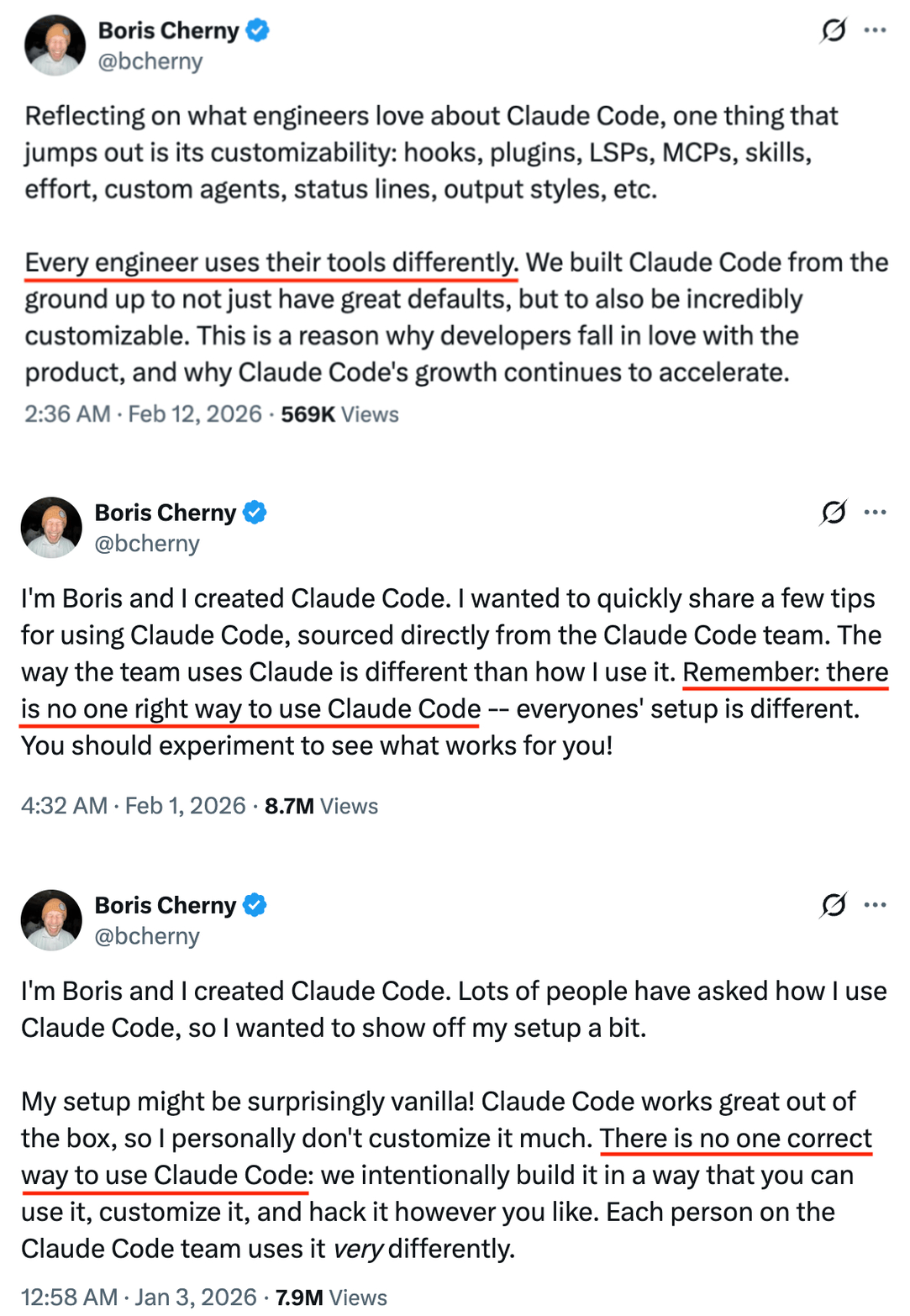
Boris Cherny on X (tweet 1 · tweet 2 · tweet 3)
🧠 CONCEPTS
| Feature | Location | Description |
|---|---|---|
| Subagents |
.claude/agents/<name>.md |
Autonomous actor in fresh isolated context — custom tools, permissions, model, memory, and persistent identity |
| Commands |
.claude/commands/<name>.md |
Knowledge injected into existing context — simple user-invoked prompt templates for workflow orchestration |
| Skills |
.claude/skills/<name>/SKILL.md |
Knowledge injected into existing context — configurable, preloadable, auto-discoverable, with context forking and progressive disclosure · Official Skills |
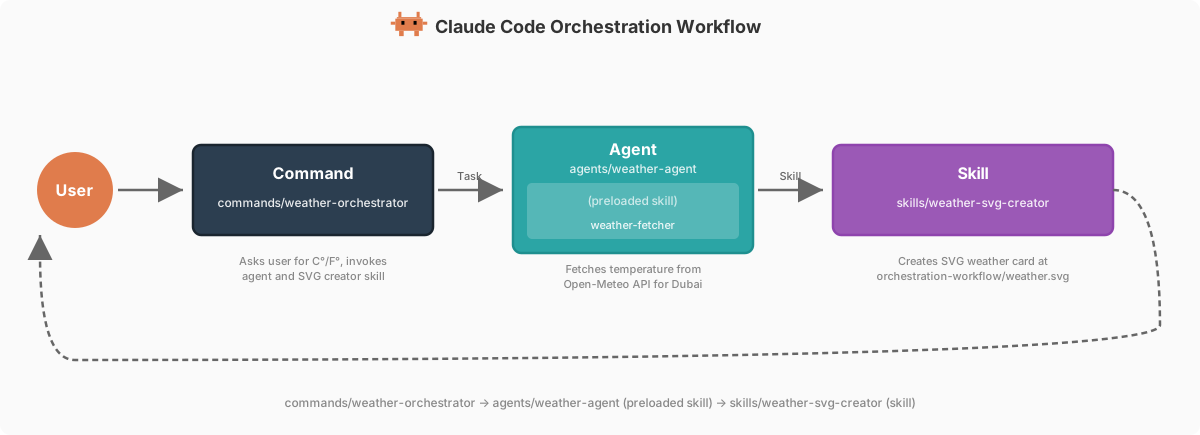
| Workflows | .claude/commands/weather-orchestrator.md |
|
| Hooks | .claude/hooks/ |
User-defined handlers (scripts, HTTP, prompts, agents) that run outside the agentic loop on specific events · Guide |
| MCP Servers | .claude/settings.json, .mcp.json |
Model Context Protocol connections to external tools, databases, and APIs |
| Plugins | distributable packages | Bundles of skills, subagents, hooks, MCP servers, and LSP servers · Marketplaces · Create Marketplaces |
| Settings | .claude/settings.json |
Hierarchical configuration system · Permissions · Model Config · Output Styles · Sandboxing · Keybindings · Fast Mode |
| Status Line | .claude/settings.json |
Customizable status bar showing context usage, model, cost, and session info |
| Memory | CLAUDE.md, .claude/rules/, ~/.claude/rules/, ~/.claude/projects/<project>/memory/ |
Persistent context via CLAUDE.md files and @path imports · Auto Memory · Rules |
| Checkpointing | automatic (git-based) | Automatic tracking of file edits with rewind (Esc Esc or /rewind) and targeted summarization |
| CLI Startup Flags | claude [flags] |
Command-line flags, subcommands, and environment variables for launching Claude Code · Interactive Mode |
| AI Terms | Agentic Engineering · Context Engineering · Vibe Coding |
|
| Best Practices | Official best practices · Prompt Engineering · Extend Claude Code |
🔥 Hot
| Feature | Location | Description |
|---|---|---|
Auto Mode  |
--permission-mode auto |
Background safety classifier replaces manual permission prompts — Claude decides what's safe while blocking prompt injection and risky escalations · Blog |
| Channels |
--channels, plugin-based |
Push events from Telegram, Discord, or webhooks into a running session — Claude reacts while you're away · Reference |
| Slack | @Claude in Slack |
Mention @Claude in team chat with a coding task — routes to Claude Code web sessions for bug fixes, code reviews, and parallel task execution |
| Code Review |
GitHub App (managed) | Multi-agent PR analysis that catches bugs, security vulnerabilities, and regressions · Blog |
| GitHub Actions | .github/workflows/ |
Automate PR reviews, issue triage, and code generation in CI/CD pipelines · GitLab CI/CD |
| Chrome |
--chrome, extension |
Browser automation via Claude in Chrome — test web apps, debug with console, automate forms, extract data from pages |
| Scheduled Tasks | /loop, /schedule, cron tools |
/loop runs prompts locally on a recurring schedule (up to 3 days) · /schedule runs prompts in the cloud on Anthropic infrastructure — works even when your machine is off · Announcement |
| Voice Dictation |
/voice |
Push-to-talk speech input for prompts with 20-language support and rebindable activation key |
| Simplify & Batch | /simplify, /batch |
Built-in skills for code quality and bulk operations — simplify refactors for reuse and efficiency, batch runs commands across files |
| Agent Teams |
built-in (env var) | Multiple agents working in parallel on the same codebase with shared task coordination |
| Remote Control | /remote-control, /rc |
Continue local sessions from any device — phone, tablet, or browser · Headless Mode |
| Git Worktrees | built-in | Isolated git branches for parallel development — each agent gets its own working copy |
| Ralph Wiggum Loop | plugin | Autonomous development loop for long-running tasks — iterates until completion |

See orchestration-workflow for implementation details of Command → Agent → Skill pattern.
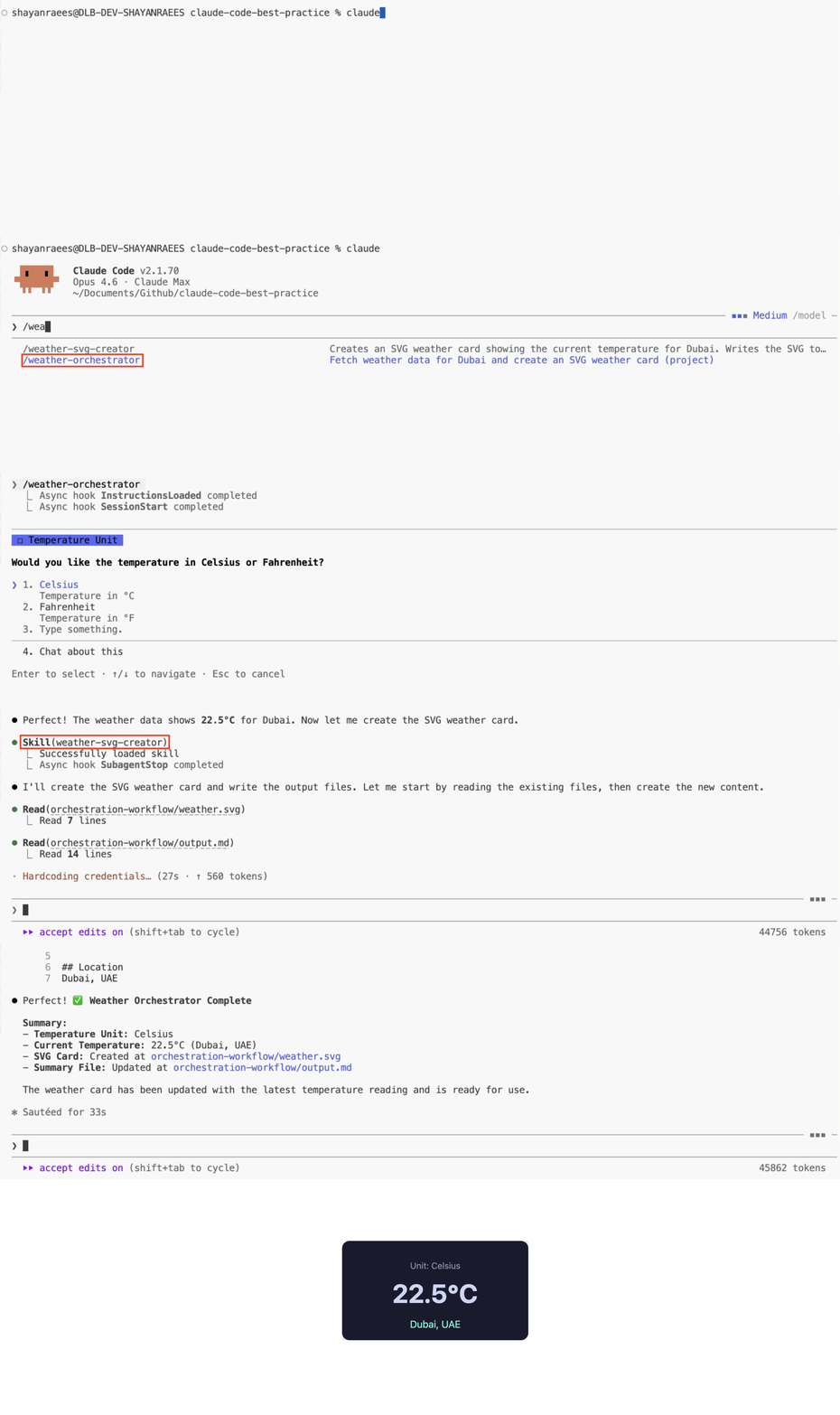

claude
/weather-orchestrator
⚙️ DEVELOPMENT WORKFLOWS
All major workflows converge on the same architectural pattern: Research → Plan → Execute → Review → Ship
| Name | ★ | Uniqueness | Plan | |
|
|
|---|---|---|---|---|---|---|
| Superpowers | 122k |    |
writing-plans |
5 | 3 | 14 |
| Everything Claude Code | 116k |    |
planner |
30 | 63 | 135 |
| Spec Kit | 83k |    |
speckit.plan |
0 | 9+ | 0 |
| gstack | 55k |    |
autoplan |
0 | 0 | 28 |
| Get Shit Done | 44k |    |
gsd-planner |
18 | 57 | 0 |
| BMAD-METHOD | 43k |    |
bmad-create-prd |
0 | 0 | 40 |
| OpenSpec | 35k |    |
opsx:propose |
0 | 11 | 0 |
| Compound Engineering | 12k |    |
ce-plan |
48 | 4 | 42 |
| HumanLayer | 10k |    |
create_plan |
6 | 27 | 0 |
Others
- Cross-Model (Claude Code + Codex) Workflow
- RPI
- Ralph Wiggum Loop
- Andrej Karpathy (Founding Member, OpenAI) Workflow
- Peter Steinberger (Creator of OpenClaw) Workflow
- Boris Cherny (Creator of Claude Code) Workflow — 13 Tips · 10 Tips · 12 Tips · 2 Tips · 15 Tips
💡 TIPS AND TRICKS (86)
🚫👶 = do not babysit
Prompting · Planning · CLAUDE.md · Agents · Commands · Skills · Hooks · Workflows · Advanced · Git / PR · Debugging · Utilities · Daily

| Tip | Source |
|---|---|
| challenge Claude — "grill me on these changes and don't make a PR until I pass your test." or "prove to me this works" and have Claude diff between main and your branch 🚫👶 | |
| after a mediocre fix — "knowing everything you know now, scrap this and implement the elegant solution" 🚫👶 | |
| Claude fixes most bugs by itself — paste the bug, say "fix", don't micromanage how 🚫👶 | |
| Tip | Source |
|---|---|
| always start with plan mode | |
| start with a minimal spec or prompt and ask Claude to interview you using AskUserQuestion tool, then make a new session to execute the spec |  |
| always make a phase-wise gated plan, with each phase having multiple tests (unit, automation, integration) | |
| spin up a second Claude to review your plan as a staff engineer, or use cross-model for review | |
| write detailed specs and reduce ambiguity before handing work off — the more specific you are, the better the output | |
| prototype > PRD — build 20-30 versions instead of writing specs, the cost of building is low so take many shots |  |
■ CLAUDE.md (7)
| Tip | Source |
|---|---|
| CLAUDE.md should target under 200 lines per file. 60 lines in humanlayer (still not 100% guaranteed) |  |
| wrap domain-specific CLAUDE.md rules in <important if="..."> tags to stop Claude from ignoring them as files grow longer | |
| use multiple CLAUDE.md for monorepos — ancestor + descendant loading | |
| use .claude/rules/ to split large instructions | |
| memory.md, constitution.md does not guarantee anything | |
| any developer should be able to launch Claude, say "run the tests" and it works on the first try — if it doesn't, your CLAUDE.md is missing essential setup/build/test commands | |
| keep codebases clean and finish migrations — partially migrated frameworks confuse models that might pick the wrong pattern | |
use settings.json for harness-enforced behavior (attribution, permissions, model) — don't put "NEVER add Co-Authored-By" in CLAUDE.md when attribution.commit: "" is deterministic |
 |
| Tip | Source |
|---|---|
| have feature specific sub-agents (extra context) with skills (progressive disclosure) instead of general qa, backend engineer | |
| say "use subagents" to throw more compute at a problem — offload tasks to keep your main context clean and focused 🚫👶 | |
| agent teams with tmux and git worktrees for parallel development | |
| use test time compute — separate context windows make results better; one agent can cause bugs and another (same model) can find them | |
| Tip | Source |
|---|---|
| use commands for your workflows instead of sub-agents | |
use slash commands for every "inner loop" workflow you do many times a day — saves repeated prompting, commands live in .claude/commands/ and are checked into git |
|
if you do something more than once a day, turn it into a skill or command — build /techdebt, context-dump, or analytics commands |
|
| Tip | Source |
|---|---|
| use context: fork to run a skill in an isolated subagent — main context only sees the final result, not intermediate tool calls. The agent field lets you set the subagent type |  |
| use skills in subfolders for monorepos | |
| skills are folders, not files — use references/, scripts/, examples/ subdirectories for progressive disclosure | |
| build a Gotchas section in every skill — highest-signal content, add Claude's failure points over time | |
| skill description field is a trigger, not a summary — write it for the model ("when should I fire?") | |
| don't state the obvious in skills — focus on what pushes Claude out of its default behavior 🚫👶 | |
| don't railroad Claude in skills — give goals and constraints, not prescriptive step-by-step instructions 🚫👶 | |
| include scripts and libraries in skills so Claude composes rather than reconstructs boilerplate | |
embed !`command` in SKILL.md to inject dynamic shell output into the prompt — Claude runs it on invocation and the model only sees the result |
|
| Tip | Source |
|---|---|
| use on-demand hooks in skills — /careful blocks destructive commands, /freeze blocks edits outside a directory | |
| measure skill usage with a PreToolUse hook to find popular or undertriggering skills | |
| use a PostToolUse hook to auto-format code — Claude generates well-formatted code, the hook handles the last 10% to avoid CI failures | |
| route permission requests to Opus via a hook — let it scan for attacks and auto-approve safe ones 🚫👶 | |
| use a Stop hook to nudge Claude to keep going or verify its work at the end of a turn | |
| Tip | Source |
|---|---|
| avoid agent dumb zone, do manual /compact at max 50%. Use /clear to reset context mid-session if switching to a new task | |
| vanilla cc is better than any workflows with smaller tasks | |
| use /model to select model and reasoning, /context to see context usage, /usage to check plan limits, /extra-usage to configure overflow billing, /config to configure settings — use Opus for plan mode and Sonnet for code to get the best of both |  |
| always use thinking mode true (to see reasoning) and Output Style Explanatory (to see detailed output with ★ Insight boxes) in /config for better understanding of Claude's decisions | |
| use ultrathink keyword in prompts for high effort reasoning | |
| /rename important sessions (e.g. [TODO - refactor task]) and /resume them later — label each instance when running multiple Claudes simultaneously | |
| use Esc Esc or /rewind to undo when Claude goes off-track instead of trying to fix it in the same context |
| Tip | Source |
|---|---|
| use ASCII diagrams a lot to understand your architecture | |
| use /loop for local recurring monitoring (up to 3 days) · use /schedule for cloud-based recurring tasks that run even when your machine is off | |
| use Ralph Wiggum plugin for long-running autonomous tasks | |
| /permissions with wildcard syntax (Bash(npm run *), Edit(/docs/**)) instead of dangerously-skip-permissions | |
| /sandbox to reduce permission prompts with file and network isolation — 84% reduction internally | |
| invest in product verification skills (signup-flow-driver, checkout-verifier) — worth spending a week to perfect | |
| Tip | Source |
|---|---|
| keep PRs small and focused — p50 of 118 lines (141 PRs, 45K lines changed in a day), one feature per PR, easier to review and revert | |
| always squash merge PRs — clean linear history, one commit per feature, easy git revert and git bisect | |
| commit often — try to commit at least once per hour, as soon as task is completed, commit | |
| tag @claude on a coworker's PR to auto-generate lint rules for recurring review feedback — automate yourself out of code review 🚫👶 | |
| use /code-review for multi-agent PR analysis — catches bugs, security vulnerabilities, and regressions before merge | |
| Tip | Source |
|---|---|
| make it a habit to take screenshots and share with Claude whenever you are stuck with any issue | |
| use mcp (Claude in Chrome, Playwright, Chrome DevTools) to let claude see chrome console logs on its own | |
| always ask claude to run the terminal (you want to see logs of) as a background task for better debugging | |
| /doctor to diagnose installation, authentication, and configuration issues | |
| error during compaction can be resolved by using /model to select a 1M token model, then running /compact | |
| use a cross-model for QA — e.g. Codex for plan and implementation review | |
| agentic search (glob + grep) beats RAG — Claude Code tried and discarded vector databases because code drifts out of sync and permissions are complex | |
| Tip | Source |
|---|---|
| iTerm/Ghostty/tmux terminals instead of IDE (VS Code/Cursor) | |
| Wispr Flow for voice prompting (10x productivity) | |
| claude-code-hooks for claude feedback | |
| status line for context awareness and fast compacting | |
| explore settings.json features like Plans Directory, Spinner Verbs for a personalized experience | |
| Tip | Source |
|---|---|
| update Claude Code daily and start your day by reading the changelog | |
| follow r/ClaudeAI, r/ClaudeCode |  |
| follow Boris, Thariq, Cat, Lydia, Noah, Anthony, Alex, Kenneth, Claude |  |

| Article / Tweet | Source |
|---|---|
| 15 Hidden & Under-Utilized Features in Claude Code (Boris) | 30/Mar/26 | Tweet |
| Squash Merging & PR Size Distribution (Boris) | 25/Mar/26 | Tweet |
| Lessons from Building Claude Code: How We Use Skills (Thariq) | 17/Mar/26 | Article |
| Code Review & Test Time Compute (Boris) | 10/Mar/26 | Tweet |
| /loop — schedule recurring tasks for up to 3 days (Boris) | 07 Mar 2026 | Tweet |
| AskUserQuestion + ASCII Markdowns (Thariq) | 28 Feb 2026 | Tweet |
| Seeing like an Agent - lessons from building Claude Code (Thariq) | 28 Feb 2026 | Article |
| Git Worktrees - 5 ways how boris is using | 21 Feb 2026 | Tweet |
| Lessons from Building Claude Code: Prompt Caching Is Everything (Thariq) | 20 Feb 2026 | Article |
| 12 ways how people are customizing their claudes (Boris) | 12/Feb/26 | Tweet |
| 10 tips for using Claude Code from the team (Boris) | 01/Feb/26 | Tweet |
| How I use Claude Code — 13 tips from my surprisingly vanilla setup (Boris) | 03/Jan/26 | Tweet |
| Ask Claude to interview you using AskUserQuestion tool (Thariq) | 28/Dec/25 | Tweet |
| Always use plan mode, give Claude a way to verify, use /code-review (Boris) | 27/Dec/25 | Tweet |

| Video / Podcast | YouTube |
|---|---|
| Building Claude Code with Boris Cherny (Boris) | 04 Mar 2026 | The Pragmatic Engineer | YouTube |
| Head of Claude Code: What happens after coding is solved (Boris) | 19 Feb 2026 | Lenny's Podcast | YouTube |
| Inside Claude Code With Its Creator Boris Cherny (Boris) | 17 Feb 2026 | Y Combinator | YouTube |
| Boris Cherny (Creator of Claude Code) On What Grew His Career (Boris) | 15 Dec 2025 | Ryan Peterman | YouTube |
| The Secrets of Claude Code From the Engineers Who Built It (Cat) | 29 Oct 2025 | Every | YouTube |
☠️ STARTUPS / BUSINESSES
| Claude | Replaced |
|---|---|
| Code Review | Greptile, CodeRabbit, Devin Review, OpenDiff, Cursor BugBot |
| Voice Dictation | Wispr Flow, SuperWhisper |
| Remote Control | OpenClaw |
| Cowork | OpenAI Operator, AgentShadow |
| Tasks | Beads |
| Plan Mode | Agent OS |
| Skills / Plugins | YC AI wrapper startups (reddit) |

If you have answers, do let me know at shanraisshan@gmail.com
Memory & Instructions (4)
- What exactly should you put inside your CLAUDE.md — and what should you leave out?
- If you already have a CLAUDE.md, is a separate constitution.md or rules.md actually needed?
- How often should you update your CLAUDE.md, and how do you know when it's become stale?
- Why does Claude still ignore CLAUDE.md instructions — even when they say MUST in all caps? (reddit)
Agents, Skills & Workflows (6)
- When should you use a command vs an agent vs a skill — and when is vanilla Claude Code just better?
- How often should you update your agents, commands, and workflows as models improve?
- Does giving your subagent a detailed persona improve quality? What does a "perfect persona/prompt" for research/QA subagent look like?
- Should you rely on Claude Code's built-in plan mode — or build your own planning command/agent that enforces your team's workflow?
- If you have a personal skill (e.g., /implement with your coding style), how do you incorporate community skills (e.g., /simplify) without conflicts — and who wins when they disagree?
- Are we there yet? Can we convert an existing codebase into specs, delete the code, and have AI regenerate the exact same code from those specs alone?
Specs & Documentation (3)
- Should every feature in your repo have a spec as a markdown file?
- How often do you need to update specs so they don't become obsolete when a new feature is implemented?
- When implementing a new feature, how do you handle the ripple effect on specs for other features?
REPORTS









1. Read the repo like a course, learn what commands, agents, skills, and hooks are before trying to use them.
2. Clone this repo and play with the examples, try /weather-orchestrator, listen to the hook sounds, run agent teams, so you can see how things actually work.
3. Go to your own project and ask Claude to suggest what best practices from this repo you should add, give it this repo as a reference so it knows what's possible.
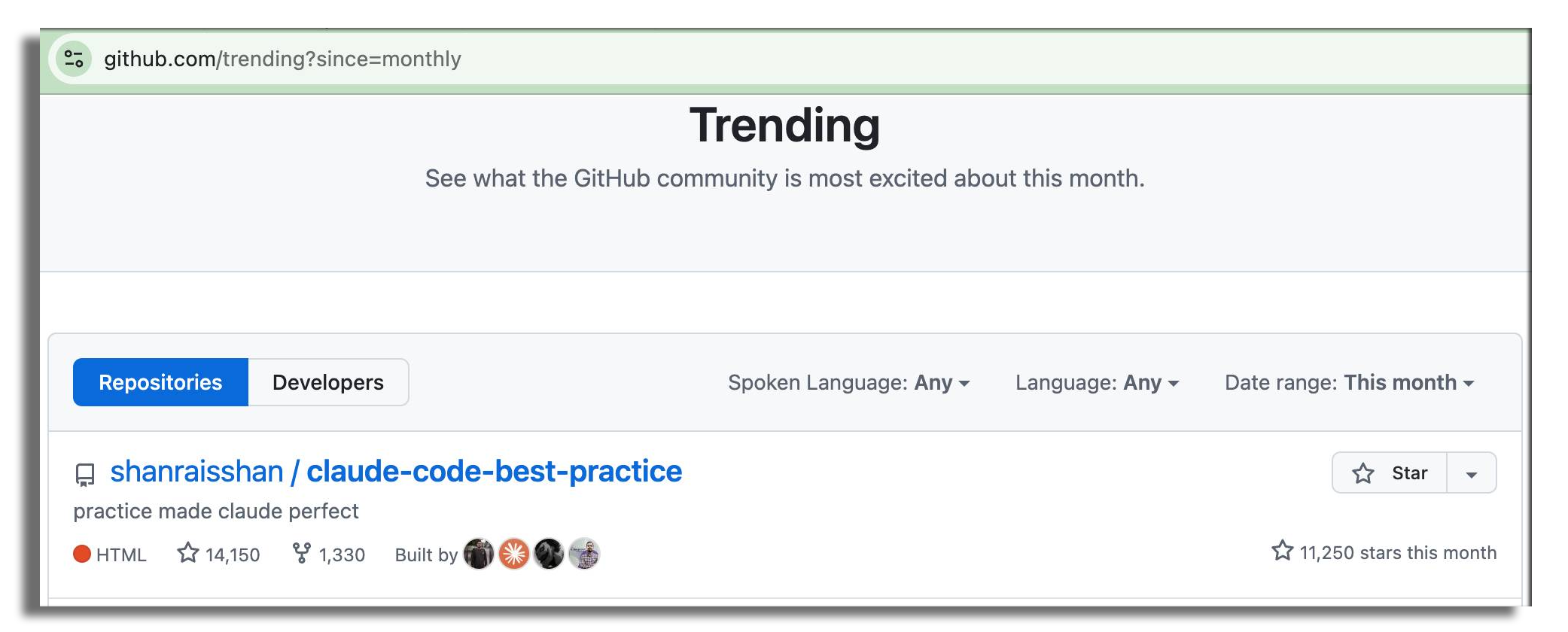
✨Trending on Github in March 2026✨
Other Repos
 claude-code-hooks ·
  codex-cli-best-practice ·
  codex-cli-hooks
Developed by

Workflow Description /workflows:development-workflows Update the DEVELOPMENT WORKFLOWS table and cross-workflow analysis report by researching all 8 workflow repos in parallel /workflows:best-practice:workflow-concepts Update the README CONCEPTS section with the latest Claude Code features and concepts /workflows:best-practice:workflow-claude-settings Track Claude Code settings report changes and find what needs updating /workflows:best-practice:workflow-claude-subagents Track Claude Code subagents report changes and find what needs updating /workflows:best-practice:workflow-claude-commands Track Claude Code commands report changes and find what needs updating /workflows:best-practice:workflow-claude-skills Track Claude Code skills report changes and find what needs updating




Star History
freeCodeCamp.org's open-source codebase and curriculum. Learn math, programming, and computer science for free.



freeCodeCamp.org's open-source codebase and curriculum
freeCodeCamp.org is a friendly community where you can learn to code for free. It is run by a donor-supported 501(c)(3) charity to help millions of busy adults transition into tech. Our community has already helped more than 100,000 people get their first developer job.
Our full-stack web development and machine learning curriculum is completely free and self-paced. We have thousands of interactive coding challenges to help you expand your skills.
Table of Contents
- Certifications
- The Learning Platform
- Reporting Bugs and Issues
- Reporting Security Issues and Responsible Disclosure
- Contributing
- Platform, Build and Deployment Status
- License
Certifications
freeCodeCamp.org offers several free developer certifications that make up the Full-Stack Developer Curriculum:
- Responsive Web Design
- JavaScript
- Front-End Development Libraries
- Python
- Relational Databases
- Back-End Development and APIs
Each of these certifications involves completing interactive lessons, workshops, labs, reviews, and quizzes. Throughout the certification, you'll need to complete 5 required projects to qualify for the exam. Once you pass the exam, then you can claim the certification.
freeCodeCamp.org also offers free language certifications designed around internationally recognized proficiency levels:
- A2 English for Developers (Beta)
- B1 English for Developers (Beta)
- A1 Professional Spanish (Beta)
- A1 Professional Chinese (Beta)
Each of these certifications is organized into modules, with sections for warm-ups, lessons, practice exercises, review pages, and quizzes to ensure you fully grasp the material before progressing to the next module. You'll need to complete all of the quizzes in order to qualify for the exam at the end of the certification.
Once you've earned a certification, you will always have it. You will always be able to link to it from your LinkedIn or resume. And when your prospective employers or freelance clients click that link, they'll see a verified certification specific to you.
The one exception to this is if we discover violations of our Academic Honesty Policy. When we catch people unambiguously plagiarizing (submitting other people's code or projects as their own without citation), we do what all rigorous institutions of learning should do - we revoke their certifications and ban those people.
In addition, to help prepare for job interviews, freeCodeCamp.org includes The Odin Project (freeCodeCamp Remix), Coding Interview Prep, Project Euler, and Rosetta Code.
A free, professional Foundational C# with Microsoft Certification is also available.
The Learning Platform
This code is running live at freeCodeCamp.org.
Our community also has:
- A forum where you can usually get programming help or project feedback within hours.
- A YouTube channel with free courses on Python, SQL, Android, and a wide variety of other technologies.
- A technical publication with thousands of programming tutorials and articles about mathematics and computer science.
- A Discord server where you can hang out and talk with developers and people who are learning to code.
Join the community here.
Reporting Bugs and Issues
If you think you've found a bug, first read the how to report a bug article and follow its instructions.
If you're confident it's a new bug and have confirmed that someone else is facing the same issue, go ahead and create a new GitHub issue. Be sure to include as much information as possible so we can reproduce the bug.
Reporting Security Issues and Responsible Disclosure
We appreciate responsible disclosure of vulnerabilities that might impact the integrity of our platforms and users.
Read our security policy and follow these steps to report a vulnerability.
Contributing
The freeCodeCamp.org community is possible thanks to thousands of kind volunteers like you. We welcome all contributions to the community and are excited to welcome you aboard.
Please follow these steps to contribute.
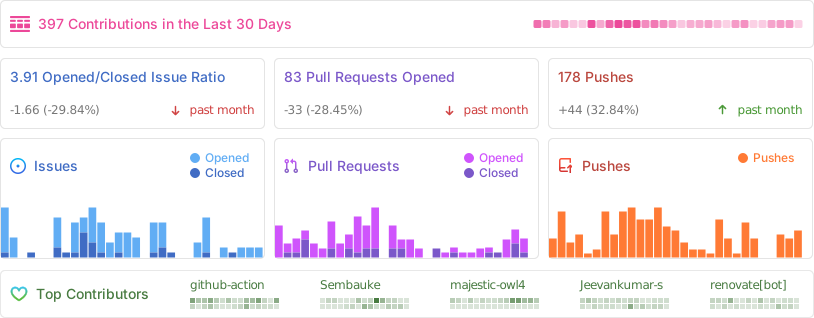
Recent Contributions:
License
Copyright © 2014 freeCodeCamp.org
The content of this repository is bound by the following licenses:
- The computer software is licensed under the BSD-3-Clause license.
- The learning resources in the
/curriculumdirectory including their subdirectories therein are copyright © 2014 freeCodeCamp.org